
Difficult Conversations
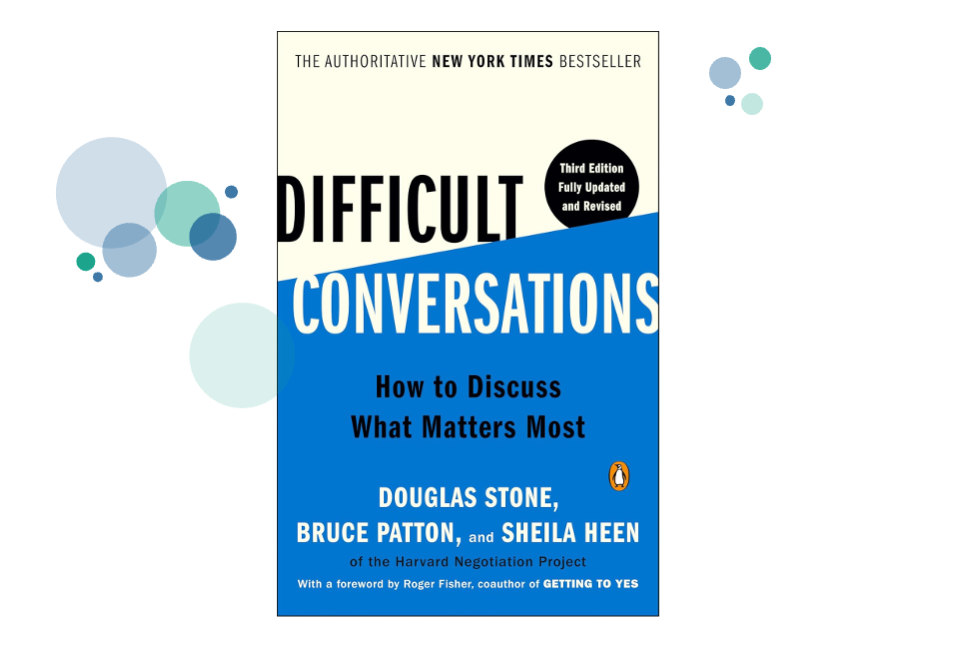
Book: Difficult Conversations: How to Discuss What Matters Most
Authors: Douglas Stone, Bruce Patton, and Sheila Heen
by Trista Schoonmaker
Why Does It Matter?
Let’s be honest—nobody loves having difficult conversations. Whether it’s giving hard feedback, bringing up a sensitive topic with a colleague, or sorting out a disagreement with a peer, these moments are just uncomfortable. That’s where this book comes in. It’s one of the first I read when I started focusing my career on workplace conflict, and I still go back to it again and again.
Written by negotiation experts from Harvard, this book breaks down why these talks are so hard and how to handle them without blowing things up—or bottling everything inside. With relatable examples to guide you, the book shows how shifting your mindset and choosing your words carefully can turn high-stress moments into problem-solving opportunities. It’s not about having all the right answers; it’s about creating space for honest, respectful dialogue that actually gets somewhere.
If you read only one book on communicating through hard times, make it this one.
My Key Insights
Difficult Conversations is packed with more practical advice than you can absorb in just one reading. Here are just two insights that changed the way I approach tough moments.
1. “Disentangle Intent from Impact”
Have you ever had the experience of saying something that landed on someone entirely differently than you anticipated? You’re not alone. Your good intentions don’t guarantee a good impact on others. And that difference between our intent and our impact can lead to all sorts of tension. How?
We tend to judge ourselves based on our intent, and we tend to judge others based on their impact on us. So in a conflict, it’s easy to give ourselves the benefit of the doubt and see ourselves as the “good guy,” while simultaneously blaming the other for the way they made us feel.
We assume we know the other’s intentions based on the impact on us—so if we feel bad, it’s easy to assume they intended that we feel bad. That’s not always true, and the assumption sets us up for deep misunderstandings.
We assume our good intentions make up for whatever negative impact we’ve had. That means apologies may focus more on what we meant rather than focusing on the negative mark our words or actions left. That can leave others feeling dismissed and unheard, which is a recipe for future tension between them.
This chapter in the book is a reminder that how we affect others matters as much as—and perhaps even more—than “what we meant.” It’s a powerful call to greater self-awareness about how we come across and whether we might be the problem.
2. “Map the Contribution System”
Too often when we are in conflict with someone, we spend an enormous amount of time looking for who to blame. Sound familiar? Turns out, it’s not an effective use of our time! Conflicts are resolved when we approach them as problem-solving together with the other. Focusing on who’s to blame slows down the solution and can leave us in a cycle of misunderstanding.
Instead of asking, “Whose fault is this?” or “How can I prove I didn’t do anything wrong here?”, a better question is “How did we each contribute to bringing about the current situation?” That question leads to a place of curiosity and exploration together rather than getting stuck in the blame game. Acknowledging your own contributions to what’s happened changes the tone of the conversation. In the end, it can easily lead to the conversation around how to be sure the current situation doesn’t happen again—all without wrongly placing the weight of the blame on one person.
How Can I Use This?
Next time you’re in a tense situation, ask yourself two questions:
Am I sure I understand what my impact was on the other, not just my intention?
What are the different contributions that led to this situation, including my own?
Difficult Conversations doesn’t make these tough moments any more fun, but at least it makes them more doable. Have you got a conversation you’ve been putting off? This book is a great place to start!