
The Gap Doesn’t Stay Empty
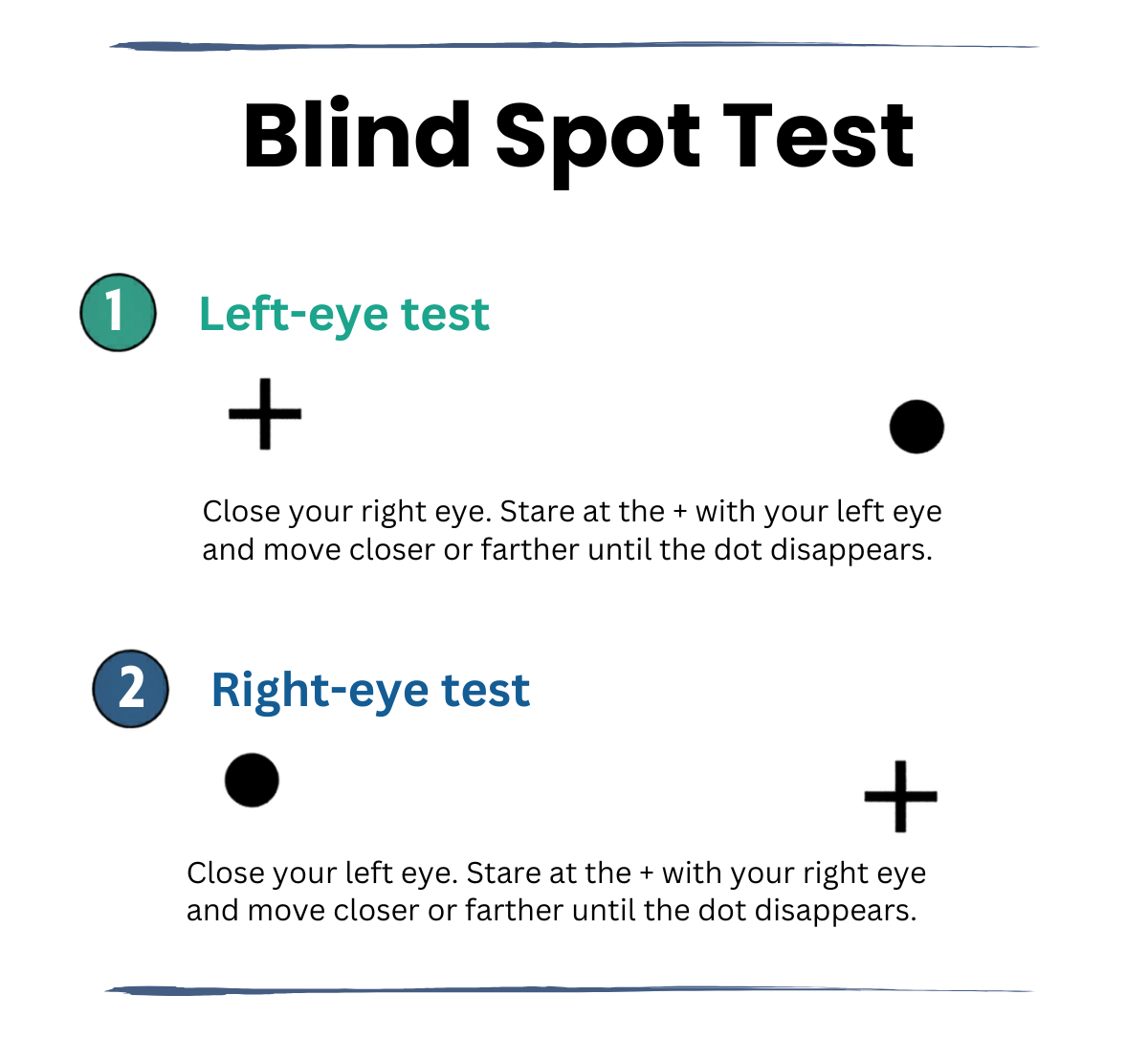
Do you remember the first time you tested yourself for a blind spot in your sight?
I think I was under ten years old, and (if I’m remembering right) it was in a Childcraft Encyclopedia—the source of all knowledge for Midwest ’80s kids. The test looked something like the recreation here. I remember moving the book back and forth, trying to find the exact distance where it would happen. . .
. . .and then the dot completely disappeared. I was blown away! Not because it vanished and left a hole in its place, but because the white background seemed to expand over it, as if the dot had never been there at all.
That’s the part I still find fascinating (our brains are amazing!)—the absence did not look like absence. My brain filled in the missing space so seamlessly that I experienced the page as complete.
Something similar happens in conflict.
A message comes back shorter than usual. Someone pauses before answering. A decision gets made without the context we expected. A colleague’s tone shifts in a meeting, or a leader does not respond in the way they normally would. There’s a gap between what happened and what it means.
But the gap never stays empty.
Almost immediately, your mind starts supplying meaning. The short message becomes “irritation.” The pause becomes “disapproval.” The unexplained decision becomes “exclusion.” Usually, it doesn’t feel like we are making up a story. It feels like we are seeing clearly. That’s what makes the process so difficult to catch.
Our interpretations generally don’t announce themselves as interpretations. They arrive with emotional logic, and maybe they are connected to real history, real patterns, real concerns, or real impact. Sometimes they even turn out to be partly right. But partly right is not the same as complete.
As we’ve been getting clear on what skills are important for building Conflict EQ, we’ve also realized that there are critical mindsets—and without those mindsets, the skills aren’t all that useful. Here’s one of them: “My perspective is one interpretation of the situation, not objective reality.”
If you can’t accept that mindset, it’s going to be increasingly difficult for you to work through conflict situations—which are all about different interpretations.
That does not mean ignoring what we notice. It means staying honest about the difference between what happened, what we sensed, and what we have concluded. That distinction matters because the story we form in the gap doesn’t stay private for long.
Once we believe the story, we begin participating from inside it. If we decide someone is dismissing us, we may enter the next conversation guarded. If we decide someone is avoiding accountability, our questions may start to sound more like cross-examination than curiosity. If we decide we are being excluded, we may stop offering information as freely.
At that point, we are not only reacting to tension—we’re an active part of shaping it. Conflict often escalates before anyone names it as conflict because people start responding to stories that have not been tested. The work isn’t to stop making meaning. We’re human; we interpret constantly, and no amount of self-awareness will change that. The work is to notice when meaning starts hardening into “fact.”
That childhood blind spot test stayed with me because it revealed something I hadn’t understood before. I could be missing something and still feel like I was seeing clearly.
That is a hard thing to remember in conflict. Our interpretations feel convincing because they don’t feel like guesses—they feel like the whole picture. But sometimes what feels complete is only what our minds have filled in.
If you find yourself wondering whether you’ve been filling in a gap, pause and ask yourself three questions:
What actually happened? Not the meaning or motive. Just the observable facts.
What story have I added? Consider what you might be assuming about their intention, reaction, priorities, or respect for you.
How is that story shaping my behavior?
The questions don’t erase the concern, but they do reopen the space between what happened and what it might mean. And sometimes that small space is where the conversation has a chance to change.
The Gap Doesn't Stay Empty: Q&A
What is the central idea of this article?
When information is missing, our minds automatically fill the gap with meaning. In conflict, those interpretations often feel like facts, even though they may only be one possible explanation.
What does the blind spot example teach us?
Just as our brains fill in the missing visual information in our blind spot, our minds fill in missing information in relationships and conversations. The absence doesn't feel incomplete—it feels real.
What is "the gap" in conflict?
The gap is the space between what happened and what it means.
For example:
Someone sends a short email.
A colleague pauses before responding.
A leader leaves you out of a meeting.
The event happens, but the meaning is not immediately clear.
Why doesn't the gap stay empty?
Humans are meaning-making creatures. We naturally interpret behavior, assign motives, and create explanations to make sense of uncertainty.
Why are these interpretations dangerous?
Because they don't feel like interpretations.
They feel like reality.
We often become convinced that our explanation is the correct explanation without ever testing it.
What mindset is essential for Conflict EQ?
"My perspective is one interpretation of the situation, not objective reality."
This mindset creates room for curiosity, learning, and dialogue.
Does this mean my interpretation is always wrong?
No.
Your interpretation may be partly right—or even completely right.
The challenge is recognizing that certainty often arrives before evidence.
What happens when we believe our story?
We begin behaving as though our interpretation is fact.
If we believe someone is dismissing us, we become guarded.
If we believe someone is excluding us, we withdraw.
If we believe someone is avoiding responsibility, our questions become more accusatory.
How does conflict escalate before anyone notices?
People start reacting to stories rather than to facts.
The tension grows because everyone is responding to their interpretation of events rather than exploring what actually happened.
What is the difference between observation and interpretation?
Observation:
"The email was two sentences long."
Interpretation:
"They are upset with me."
Observation:
"They paused before answering."
Interpretation:
"They disagree with me."
Observation is what happened.
Interpretation is the meaning we assign.
Why is this distinction important?
Because conflict often becomes harder to resolve when interpretations harden into certainty.
Once we are convinced we know what something means, curiosity disappears.
What are some signs that my interpretation is becoming a fact in my mind?
You stop asking questions.
You become certain about someone's intentions.
You begin preparing defenses.
You find yourself replaying the situation repeatedly.
Alternative explanations seem increasingly unlikely.
What practical tool does the article offer?
Ask yourself three questions:
What actually happened?
(Only the observable facts.)What story have I added?
(What assumptions am I making about intentions, motives, or meaning?)How is that story shaping my behavior?
(How am I showing up because of the interpretation I've created?)
What does Conflict EQ encourage us to do?
Conflict EQ encourages us to separate facts from interpretations and remain curious long enough to test our assumptions before acting on them.
What is the key leadership lesson?
The most dangerous stories in conflict are often the ones we never realize we're telling ourselves.
What is the main takeaway?
Conflict often grows not because of what happened, but because of the meaning we automatically attach to what happened. The moment we recognize our interpretation as only one possible explanation, we create space for understanding instead of escalation.