
by Trista Schoonmaker
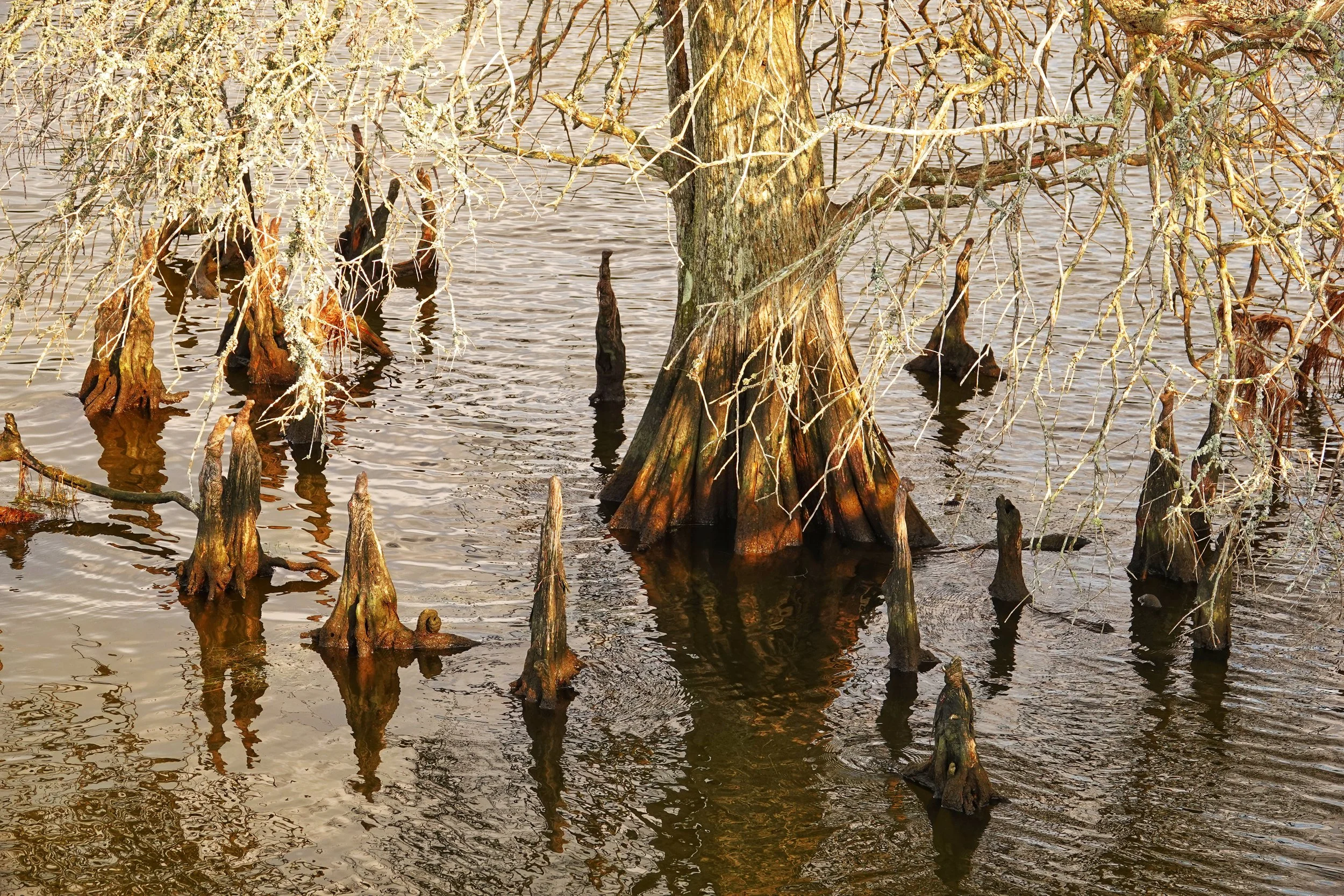
When I was down in the Outer Banks this summer, I came across a bald cypress tree standing in shallow water. What caught my attention wasn't the tree itself, but the strange woody projections surrounding it. Some were short and pointed, others tall and irregular, rising out of the water like a collection of miniature stalagmites. I took a few pictures (this one is my favorite), wondering what on earth they were.
I later learned they're called cypress knees, and they're actually extensions of the tree's root system. What looked like a collection of separate objects was part of a much larger structure, most of it hidden beneath the water.
Scientists have been studying cypress knees for nearly two centuries, but they still haven't reached a consensus about exactly what they do. Some research suggests they help deliver oxygen to submerged roots. Other theories involve structural support or adaptations to changing water levels. The knees are clearly connected to the tree, but their precise contribution to its survival remains a bit of a mystery.
With the work we do, we encounter something similar in conflict.
When people describe a difficult workplace relationship, they usually begin with what they can see. A colleague keeps challenging my decisions. A manager steps into conversations that should belong to the team. Two departments can't seem to agree on priorities. Meetings end in frustration, and the same disagreements resurface a week later.
These are real problems, and they deserve attention. But they're also the parts of the conflict that have broken the surface. Underneath may be a complicated network of competing interests, unclear expectations, past disappointments, unspoken fears, and organizational pressures.
What appears to be a disagreement about a particular decision may be connected to a much older question about who has authority. A colleague's repeated objections may reflect concerns about quality, but they may also be rooted in a history of being excluded from decisions. And what looks like a personality clash between two people may be reinforced by a system that gives them conflicting responsibilities.
Like those cypress knees, the visible problems may be connected in ways we don't immediately recognize. And even when we identify the connections, we may not fully understand what purpose they're serving.
This is one reason I find mapping conflict so valuable. When we move beyond asking “who's doing what wrong?” and begin examining the larger landscape, different possibilities emerge. Instead of treating every difficult behavior or recurring disagreement as an isolated problem, we can begin to see the relationships between them.
That doesn't mean every conflict has some hidden explanation that makes the visible behavior acceptable. People are still responsible for how they act. But addressing behavior without understanding the conditions that contribute to it can leave the underlying dynamics untouched.
Of course, seeing beneath the surface isn't easy. We rarely have access to the entire system, and our explanations are always incomplete. Even the scientists studying cypress knees are still testing their understanding of structures they can observe and measure.
I think that's a useful reminder as we approach conflict. We don't need to understand every underlying dynamic before taking action. But we do need to recognize that what we're seeing may be only part of the picture.
The next time a conflict seems to revolve around one person's behavior or one recurring disagreement, it may be worth asking: What else might this be connected to?
That question won't necessarily resolve the conflict. But it may change where we look for the solution.