
You Already Know What to Do
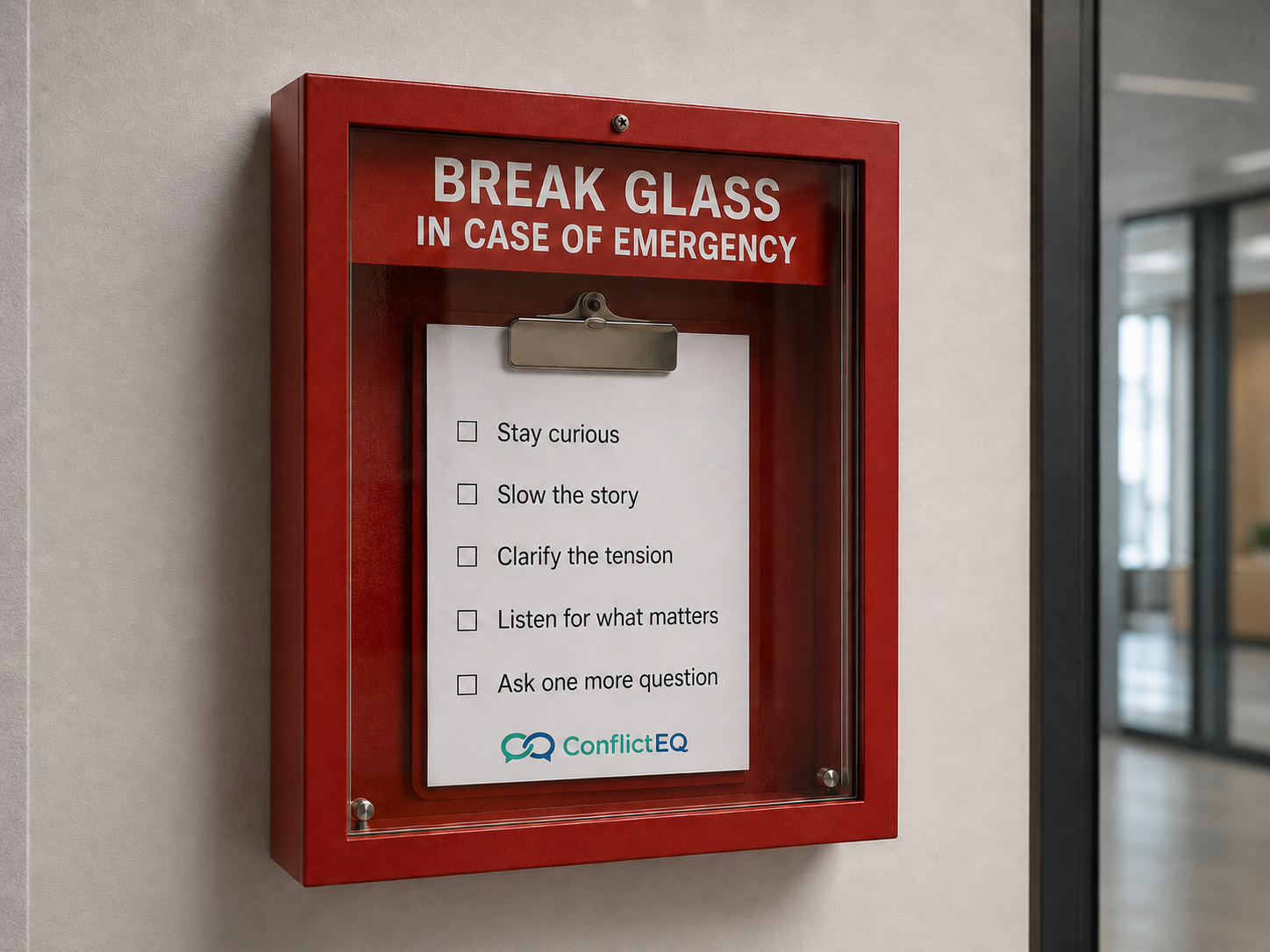
Many leaders can describe, with real accuracy, the kind of person they want to be in conflict. Is this you?
You want to listen before responding.
You want to stay curious when someone disagrees.
You want to be direct without becoming harsh, steady without becoming distant, open without losing your own point of view.
It’s not that you’ve never heard these ideas before. The problem is that conflict changes the conditions under which those ideas need to be used.
Maybe you know how to listen well in a calm conversation. . .but still interrupt people when you feel challenged in front of others. Or you believe in curiosity. . .but still move into certainty when the frustration feels personal. You value directness. . .and still soften the message so much that the real concern never becomes clear.
That gap is easy to misread.
From the outside, it can look like a skill problem. You think you need better tools, stronger language, a clearer model, the right framework for the conversation. And sometimes that’s true. There are conflict skills people have never been taught, and those skills matter! But many breakdowns happen for a different reason.
You already know enough to begin. You just can’t access what you know under pressure. That distinction sits at the center of Conflict EQ.
Conflict capacity isn’t simply the possession of skills. It’s the ability to stay connected to those skills when tension rises, identity feels implicated, stakes increase, emotions sharpen, or the room starts to feel less safe.
Pressure changes access. It narrows attention and speeds up interpretation. It makes the body prepare to defend, appease, avoid, or regain control. You might still technically “know” what a good response would be, but that knowledge becomes harder to reach. The conversation starts to feel like something to survive rather than something to understand.
This is why more information does not always produce different behavior.
You can leave a workshop with useful tools and still lose them in the moment that matters most. Not because the tools were meaningless, and not because you were unwilling, but because the real test is never whether you can explain the skill in a calm room. The real test is whether you could access the skills when the conversation carried load.
If the constraint is only skill, the answer is instruction. If the constraint is capacity, the work has to go deeper. You need practice noticing what happens inside when tension rises. You need to recognize the moment your listening collapses into rebuttal, your clarity collapses into over-explaining, or your steadiness collapses into emotional distance.
This is not remedial work! Welcome to the big leagues.
Usually, conflict doesn’t ask leaders whether they know the right answer. It asks whether they can remain steady enough to use what they know under pressure. That is where many conversations break down. Not at the level of intention, and not always at the level of skill. They break in the gap between knowing and being able.
Closing that gap is the work of building Conflict EQ capacity.
Are you building more knowledge, or are you building the capacity to use what you know when it matters?
Conflict EQ Q&A
Why do capable leaders still struggle during conflict?
Most leaders struggle in conflict not because they lack knowledge, but because pressure changes their ability to access that knowledge. When emotions rise, stakes increase, or identity feels threatened, even experienced leaders can find themselves reacting in ways that don't reflect their intentions.
What is the difference between knowing and being able?
Knowing is understanding a concept, skill, or framework. Being able is accessing and using that skill in a real-world moment when tension, uncertainty, or emotional activation are present.
Conflict often exposes the gap between the two.
Why do leaders behave differently under pressure?
Pressure changes how we process information. Attention narrows, interpretations speed up, emotions become more influential, and the body begins preparing to protect itself. As a result, leaders may lose access to curiosity, patience, perspective-taking, or thoughtful communication.
What is Conflict EQ?
Conflict EQ is the capacity to remain grounded, curious, and constructive when tension rises. It is less about learning new scripts and more about maintaining access to your best thinking and behavior when pressure increases.
Why doesn't more training always create better behavior?
Training can build awareness and skills, but awareness alone does not guarantee performance under pressure. People often leave workshops understanding exactly what they should do, only to struggle when faced with a real conflict where emotions and stakes are involved.
What happens when conflict increases emotional pressure?
As pressure rises, people often:
Listen to respond rather than understand
Become more certain of their perspective
Interrupt more frequently
Defend their position more aggressively
Avoid difficult topics
Over-explain their point of view
Withdraw emotionally from the conversation
These reactions are common human responses to perceived threat.
What is conflict capacity?
Conflict capacity is the ability to stay connected to your values, skills, and intentions while navigating tension. It is the ability to remain steady enough to access what you already know when the conversation becomes difficult.
How can I tell when my capacity is beginning to collapse?
Early signs often include:
Losing curiosity
Becoming defensive
Rehearsing responses while others speak
Feeling urgency to win or resolve the issue
Moving into certainty
Feeling emotionally distant or withdrawn
Becoming focused on protection rather than understanding
How do you build conflict capacity?
Conflict capacity develops through practice and self-awareness. Leaders build capacity by:
Noticing their reactions sooner
Reflecting on conflict patterns
Practicing emotional regulation
Staying present during discomfort
Learning to tolerate uncertainty
Building awareness of their triggers
Capacity grows through experience, reflection, and repetition.
What is the real test of conflict competence?
The real test is not whether you can explain a communication model in a training room. The real test is whether you can access that model when your heart rate rises, your assumptions activate, and the conversation carries emotional load.
What is the key lesson from this article?
Leadership rarely asks whether you know the right answer. More often, it asks whether you can remain steady enough to use what you already know when it matters most.
The gap between knowing and being able is where Conflict EQ is built.