
Conflict Mapping: When a Story Becomes a System
by Trista Schoonmaker
I’m curious about different ways people make sense of conflict, so last week I found myself sitting in a Family Constellations workshop, watching people put their problems into the room.
If you’re not familiar with the approach, that is one of its more unusual features. Something a person has been carrying internally—a family relationship, a recurring pattern, an unresolved issue—is given physical form. Other participants may stand in for people in the system. They are positioned in relation to one another, moved around, and invited to notice what changes.
I wasn’t quite sure what I would make of it. I’m still processing. I wouldn’t assume that what emerges in a constellation is an objective representation of a family or some hidden truth waiting to be uncovered.
But as I watched, I found myself fascinated by something simpler: the act of getting the problem out of someone’s head and into the room.
Something that had existed largely as a story was suddenly outside of them. They could stand back and look at it. Distance and relationship became visible. Patterns that had been difficult to notice from inside the experience became easier to see.
And I kept thinking about conflict mapping.
Mapping conflict is part of our Conflict to Connection approach, although what we do looks quite different from what I was watching in that room.
When I interview people who are inside a conflict, I almost always hear a storyline:
“She doesn’t respect me.”
“He refuses to collaborate.”
“They keep leaving us out.”
My boss doesn’t trust me.”
Those stories matter. They contain information, emotion, and the person’s particular experience of what has happened. But they also do something else: they compress something complicated into a relatively simple explanation.
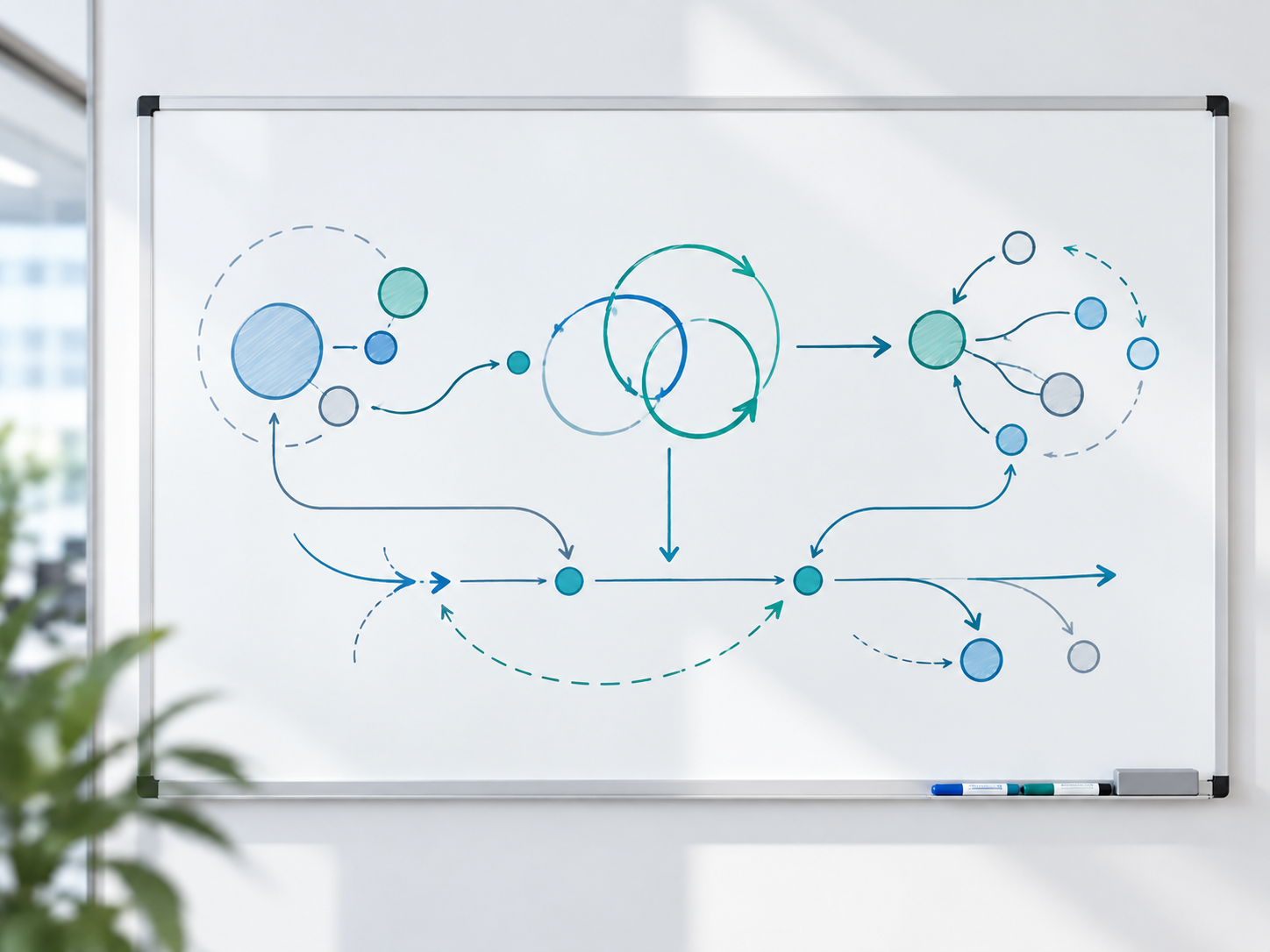
Conflict mapping turns those storylines into a system.
Instead of beginning with “Who is the problem?” or even “Who did what?”, we widen the frame and ask: “What’s contributing to the tension?”
Maybe one person has a much higher tolerance for direct disagreement than another. Maybe relational dynamics have developed over years. Maybe people are operating without clear roles, decision rights, or expectations. Maybe deadlines, staffing shortages, or organizational change are putting strain on relationships that once worked reasonably well.
Then we look at how the tension is actually showing up and what impact it is having.
Are people avoiding one another? Having the same argument repeatedly? Revisiting decisions that were supposedly settled? Working around one another instead of with one another? Is a leader spending more and more time managing friction rather than doing the work?
The picture that emerges is very different from simply deciding that two people “don’t get along.” And the distinctions matter, because different maps lead to different moves:
If the problem is primarily an unclear decision process, sending two people to conflict coaching probably won’t solve it.
If there has been a significant rupture in trust between two colleagues, clarifying the org chart won’t be enough.
And if the team is trying to collaborate in ways the work itself doesn’t actually require, improving everybody’s communication skills may still leave the underlying tension intact.
I’ve become increasingly interested in mapping before moving too quickly toward resolution for exactly this reason. The first version of a conflict story can be incredibly compelling when we are standing inside it. Certain details loom large and others almost disappear. Causes and effects blur together. We start to experience our interpretation of the conflict as the conflict itself.
Putting the situation somewhere outside ourselves, even if that simply means writing down the forces at work, creates a little space between the experience and our explanation of it. And in that space, other things can come into view.
That doesn’t mean the conflict maps I create become “the truth.” A map is still just an interpretation. Someone else might map the same situation differently. New information may change it, and some parts will always remain uncertain.
But maybe that’s part of the value. The purpose of a map is not to prove that our interpretation is correct, but to help us see more than we could see from where we were standing.
I left the Family Constellations workshop with more questions than answers. But I keep coming back to what it was like to watch someone take a story they had been carrying internally and place it somewhere they could actually look at it
While the way we map conflict is different, the underlying move feels similar–get enough distance from the story to notice what else is there. Because once we can see more of the system, we have more choices about where to move.