
Respect Starts in the Heart
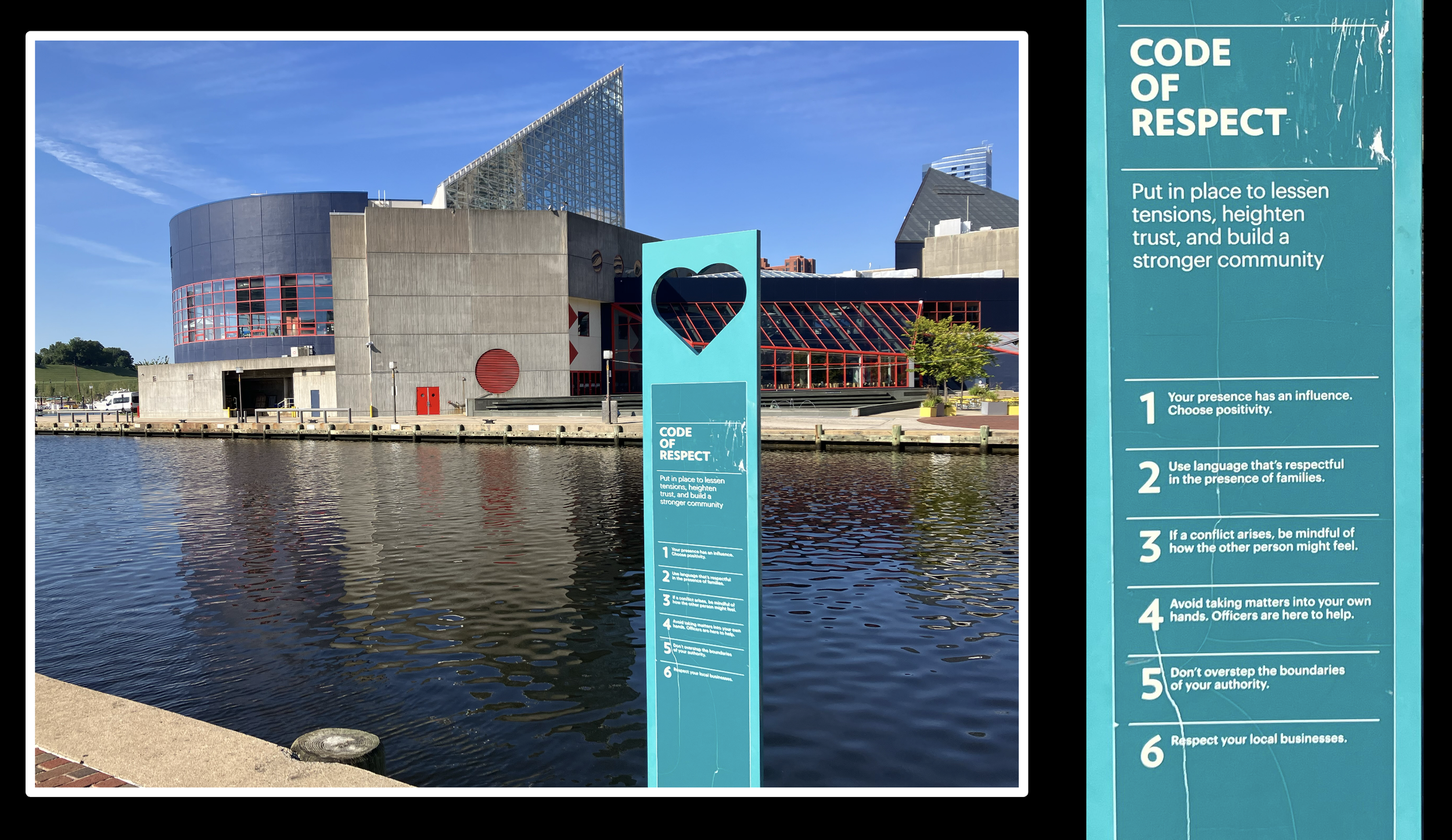
Baltimore Inner Harbor
I played hooky from work last week and spent a day wandering Baltimore’s Inner Harbor with out-of-town friends. Near the National Aquarium, we came across a sign we couldn’t just walk past.
At first, I noticed the heart, then the words underneath it: CODE OF RESPECT. The sign offers six guidelines for the people who share the Harbor, things like being mindful of how another person might feel, respecting boundaries, and remembering that your presence has an influence.
I was surprised to see it there.
Through my Conflict EQ lens, I started wondering—where did this come from? I later learned that the sign was part of a youth-led campaign called “Respect Starts in the Heart.” And the story behind that phrase turned out to be much more interesting than I expected.
This sign (and several more like it) were the creation of the Inner Harbor Project, a youth-led organization that spent years studying tensions in this particular public space. Rather than treating young people simply as part of the problem to be managed, the project trained them as researchers. They conducted focus groups with teenagers, police officers, business owners, tourists, and local residents.
Across all those groups, one word kept coming up: respect. The word was shared, but its meaning wasn’t.
The young researchers found that people were often experiencing the same encounters through very different understandings of what respect looked like. Everyone wanted it, but they didn’t necessarily recognize it in the same behaviors.
That feels remarkably familiar in workplace conflict. One person thinks, “I’m being direct.” Someone else experiences, “You’re dismissing me.” “I’m giving you space” lands on someone else as, “You’re avoiding the issue.”
“I’m holding people accountable.”
“You don’t trust me.”
“I’m trying to help.”
“You’re overstepping.”
Sometimes the disagreement isn’t really over whether respect, accountability, or collaboration matter. Both people may care deeply about the same thing. They’re colliding over what that thing looks like in practice.
What the young people behind the Inner Harbor Project did with that discovery matters. They didn’t simply decide which group had the right definition of respect. They brought perspectives from the different groups together and turned what they learned into a shared Code of Respect—something visible in the space everyone had to navigate together.
The heart I photographed is a visible artifact of the deeper work that happened before it was ever installed: discovering that a shared value wasn’t necessarily a shared understanding. Sometimes conflict isn’t hiding in a disagreement about what matters. It’s hiding in the assumption that because we’re using the same word, we mean the same thing.
All of which changes the question. Instead of asking, “Do we agree that respect matters?” we might need to ask, “What does respect look like from where you’re standing?”
The Inner Harbor Project itself closed in 2017. Nearly a decade later, its hearts still mark the Harbor—reminders that respect may start in the heart, but its meaning gets worked out between people.